Back
Back
 Articles
DORA exposes the hidden complexity of operational dependencies
Posted: 29 January 2026
Operational resilience is often understood through incidents — outages, disruptions, cyber events, and how quickly systems can be restored once something goes wrong.
DORA challenges that framing.
Rather than focusing on response alone, DORA forces a more fundamental question: do firms genuinely understand the operational dependencies that exist before an incident occurs?
For many organisations, the answer is no.
The dependency blind spot
- Which business services are truly critical
- Which ICT systems support those services
- Which third parties those systems depend on
- How those dependencies change as the organisation evolves
Most firms struggle to clearly and consistently articulate:
This information usually exists — but in fragments. Spread across teams, spreadsheets, vendor registers, and static documents that quickly fall out of date.
DORA brings this blind spot into focus by requiring firms to demonstrate a continuous understanding of their operational dependencies, not just during incidents or regulatory reviews.
Why DORA shifts the definition of resilience
DORA does not reduce resilience to incident management.
It reframes resilience as preparedness, visibility, and governance.
The regulation expects firms to understand how disruption could propagate through their operations long before a failure occurs — including where single points of failure exist, how third-party services underpin critical functions, and how risks evolve as systems, vendors, and business models change.
Without this visibility, incident response is inevitably reactive. Firms are responding to failures they never fully understood in the first place.
Why static approaches fail under DORA
- Periodic mapping exercises
- Vendor registers maintained manually
- Third-party risk assessments reviewed infrequently
- Documentation updated for regulatory deadlines
Many organisations still rely on static approaches to manage operational dependencies:
This approach does not scale under DORA.
Operational environments are dynamic. Systems change. Providers evolve. Services expand across markets. What was accurate months ago may no longer reflect reality.
DORA raises expectations precisely because regulators recognise this complexity — and expect firms to manage it continuously, not retrospectively.
Continuous visibility is now a regulatory expectation
Under DORA, firms are expected to maintain a living understanding of their operational environment.
- Monitor critical dependencies on an ongoing basis
- Maintain oversight of third-party risk
- Embed resilience considerations into governance and decision-making
- Demonstrate readiness at any point in time
This includes the ability to:
Crucially, this visibility is no longer just internal. Regulators, customers, and partners increasingly expect transparency into how organisations manage operational risk — particularly where third parties are involved.
This is where operational resilience and trust intersect.
The role of Raico’s Trust Center
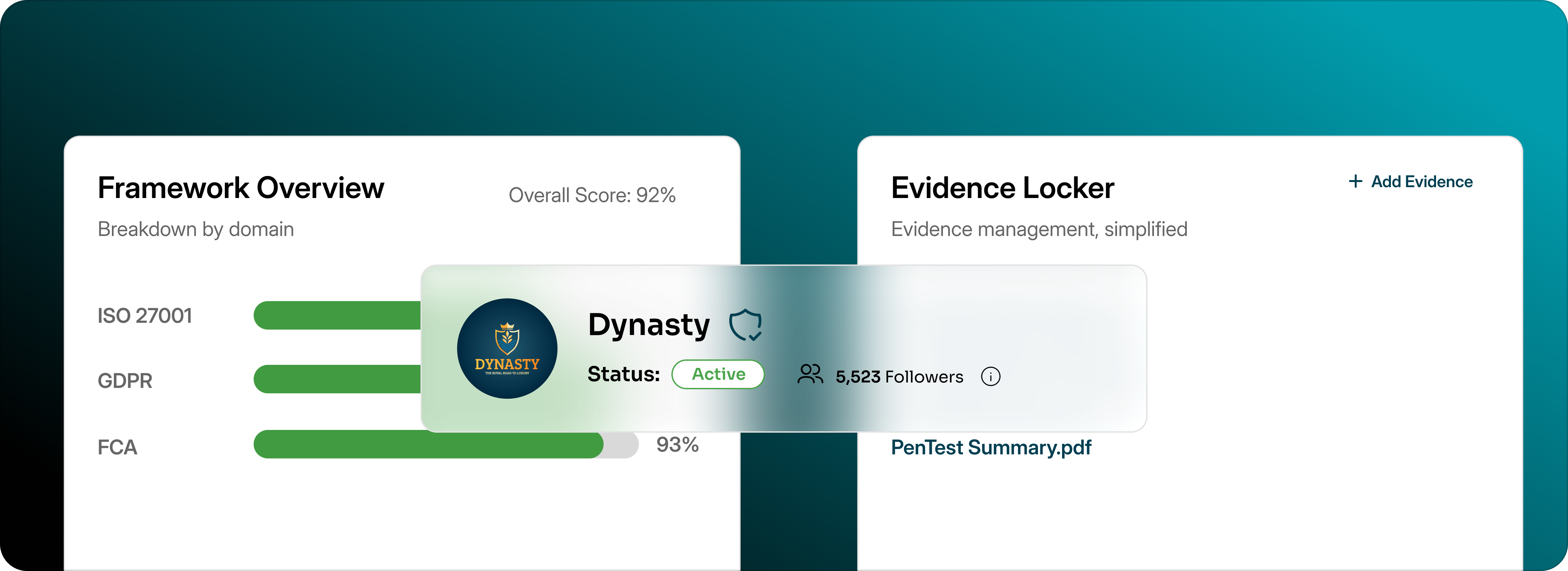
Raico’s Trust Center provides live visibility into an organisation’s compliance posture, alongside live visibility into the compliance posture of its third parties.
Under DORA, this kind of transparency becomes essential. Firms are expected not only to understand their dependencies, but to demonstrate ongoing oversight across complex third-party relationships.
Rather than relying on static documentation or repeated assurance exercises, the Trust Center provides a shared, up-to-date view of compliance and assurance. This reduces the need for constant questionnaires, enables immediate evidence exchange, and supports regulatory engagement, customer due diligence, and partner assurance without unnecessary friction.
In this context, the Trust Center is not a reporting artefact.
It becomes part of how operational governance is exercised in practice.
How Raico supports DORA-aligned resilience
Raico is built to support the shift toward continuous operational visibility that DORA requires.
The platform enables organisations to map critical services, systems, and third-party dependencies, maintain governance, controls, and evidence as those dependencies evolve, and align DORA requirements with broader regulatory and risk frameworks.
By surfacing both internal and third-party compliance posture through the live Trust Center, Raico supports ongoing oversight, transparency, and accountability — across the full ecosystem firms rely on to deliver critical services.
A clearer signal from DORA
DORA is not simply raising the bar for ICT risk management.
It is redefining what regulators expect firms to understand about their own operations.
Operational resilience is no longer measured by how quickly firms recover from disruption, but by how well they understand the structures, dependencies, and risks that make disruption possible in the first place.
DORA exposes the hidden complexity of operational dependencies.
Firms that address that complexity directly will be the ones that are truly resilient.