Back
Back
 Articles
Why compliance needed a different approach
Posted: 4 December 2025
Compliance has changed dramatically over the past decade. Regulations continue to evolve, multiply, and expand across borders — yet the way most organisations approach compliance has barely changed.
The idea for Raico was born from first-hand experience of this disconnect.
Across the founding team, we have spent years working inside the compliance ecosystem from multiple vantage points. Some of us worked closely with businesses implementing and maintaining compliance programmes. Others held senior roles at regulatory authorities, including as Senior Associates at the Financial Conduct Authority (FCA), actively assessing whether firms were meeting their financial and operational regulatory obligations.
In parallel, members of our founding team held senior leadership roles — including Vice President of Sales positions within cybersecurity companies — where compliance was not theoretical, but a direct commercial constraint.
Despite these different perspectives, we kept seeing the same pattern repeat itself.
The reality inside organisations
As regulations increased in number and complexity, compliance teams were increasingly overwhelmed. Frameworks piled up. Requirements overlapped. Responsibilities became fragmented across teams, tools, and documents.
In many organisations — even at senior management level — there was often no clear, shared understanding of what actually applied to the business. Obligations were interpreted differently across departments, jurisdictions, and functions.
- An annual policy refresh
- A last-minute audit preparation
- A scramble for documentation when a regulator came knocking
Compliance was rarely treated as a living, operational discipline. Instead, it was approached as a periodic exercise:
From a regulatory perspective, this was especially visible. During supervisory reviews and inspections, teams would rush to assemble policies, risk assessments, and evidence. Much of this material was outdated, inconsistent, or clearly created under pressure — not because it reflected the organisation's real compliance posture, but because scrutiny was imminent.
This wasn't a failure of intent or effort. It was a failure of systems.
Fragmented compliance doesn't just increase risk - it blocks growth
From the commercial side, the impact of fragmented compliance was just as clear.
In senior leadership roles within cybersecurity companies, we saw first-hand how disjointed compliance programs slowed sales cycles, delayed enterprise deals, and blocked market expansion. Security questionnaires, customer due diligence, and regulatory assurances became bottlenecks — not because teams weren't compliant, but because they couldn't prove it clearly, consistently, and at speed.
Trust was locked away in PDFs, inboxes, and spreadsheets. Every new prospect triggered another round of manual work. Growth teams were held back by compliance processes that were never designed to support scale.
Compliance wasn't just a regulatory challenge — it was a revenue problem.
The false assumption at the heart of compliance tools
Most compliance tools today are built on a flawed assumption: that organisations already know which regulations apply to them, and that each framework can be managed in isolation.
In practice, neither is true.
Businesses operate across borders. Teams collaborate globally. Products and services are sold into multiple jurisdictions. Even highly capable compliance specialists may be experts in one regulatory regime, but not in others that become relevant as the business grows. The result is duplication, over-scoping, and gaps — all at the same time.
Frameworks are treated as silos. Controls are re-implemented repeatedly. Evidence is scattered. Trust remains difficult to access when it matters most.
As regulators increasingly shift their focus toward ongoing compliance — rather than point-in-time assessments — this model is no longer sustainable.
A system problem, not a checklist problem
What became clear to us was this: compliance is not a checklist problem. It's a systems problem.
- Knowing what applies to your organisation, across jurisdictions and industries
- Understanding how requirements overlap across frameworks
- Maintaining controls, policies, and evidence continuously
- Demonstrating readiness to regulators, customers, and partners at any moment
Modern compliance requires:
Yet the tools available to teams were fragmented, reactive, and built for a different regulatory era.
Solving this requires more than digitising existing workflows — it requires intelligence embedded into the system itself.
This gap was visible both from inside regulatory bodies and from inside fast-growing businesses trying to scale responsibility under increasing scrutiny.
Why we built Raico
Raico was created to close this gap.
We set out to build a platform that reflects how compliance actually works today — and how regulators and customers increasingly expect it to work tomorrow.
Raico is an AI-driven platform, with artificial intelligence embedded at its core — not added as a bolt-on. AI underpins how regulations are interpreted, how overlap is identified across frameworks, and how compliance is maintained continuously.
- Identify which regulations and frameworks apply based on jurisdiction, industry, and structure
- Map overlapping requirements across frameworks to eliminate duplicate work
- Support continuous compliance, rather than audit-driven activity
- Enable organisations to demonstrate trust and readiness as they grow
At its core, Raico is designed to:
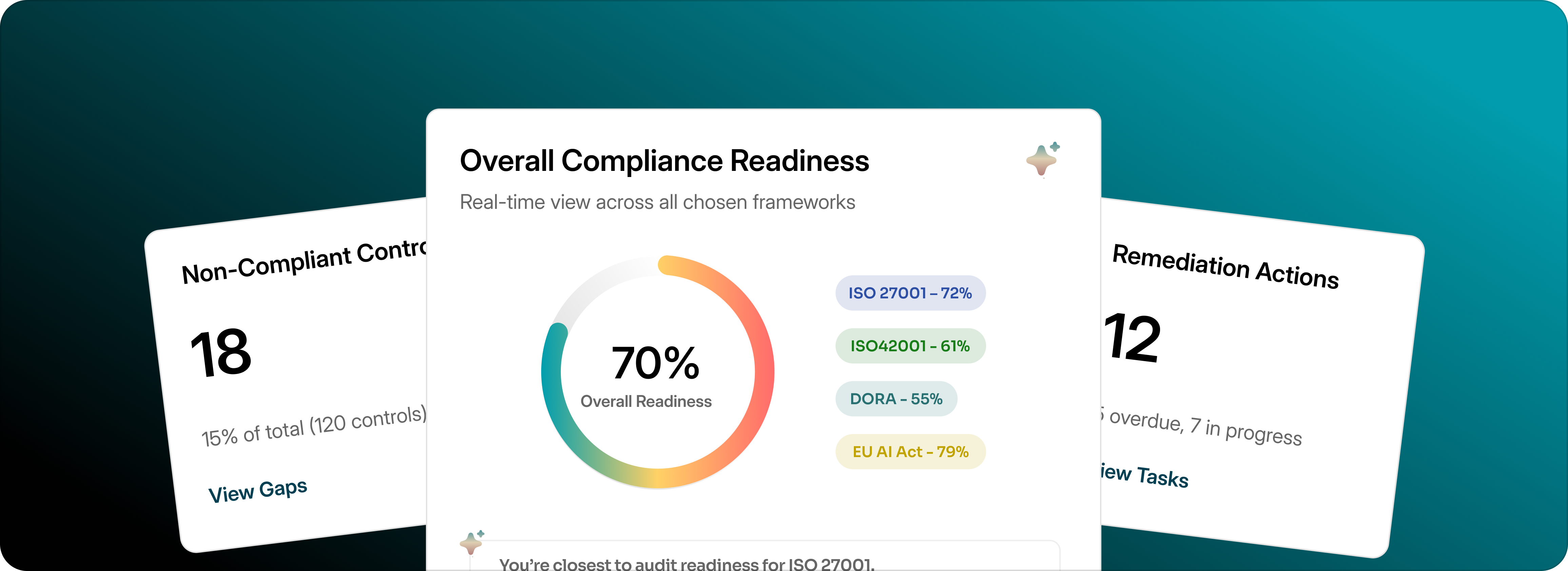
Instead of treating compliance as a collection of disconnected tasks, Raico brings controls, policies, evidence, and readiness into a single, continuously updated system — designed to support both regulatory confidence and commercial momentum.
Built for a global regulated world
We operate in an increasingly global environment. Teams are distributed. Businesses sell across borders. Regulations are drafted with cross-border impact in mind.
This is why AI is implemented across every layer of the Raico platform — enabling organisations to navigate complexity, scale across jurisdictions, and adapt as regulations evolve.
This reality demands a different approach to compliance — one that helps organisations navigate multiple frameworks and jurisdictions without restarting their efforts every time they expand, enter new markets, or engage larger customers.
Raico is built for this reality.
Our goal is not simply to help organisations "pass audits", but to help them build compliance programs that support trust, scale, and long-term growth — with confidence from regulators, partners, and customers alike.
That belief — shaped by years of experience on both sides of the compliance equation — is why Raico exists.