Back
Back
 Articles
The EU AI Act is the destination — ISO 42001 is how you get there
Posted: 16 December 2025
AI regulation is consolidating around a shared set of expectations.
Whether those expectations show up as binding law, like the EU AI Act, or as an international standard, like ISO/IEC 42001, the direction of travel is the same. Regulators, customers, and partners are converging on what “responsible AI” must look like in practice.
Different instruments.
Shared expectations.
- A clear understanding of where AI creates risk
- Defined accountability and meaningful human oversight
- Transparency into how AI systems are designed, deployed, and monitored
- Ongoing governance, not one-off compliance exercises Controls that work operationally, not just on paper
If you are building, deploying, or relying on AI systems at scale — particularly across borders — you are increasingly being asked to demonstrate the same fundamentals:
These expectations are no longer theoretical. They are becoming enforceable.
Two frameworks, one underlying model
The EU AI Act expresses these expectations through a risk-based legal framework. It classifies AI systems according to risk, defines obligations accordingly, and introduces requirements around governance, documentation, monitoring, and accountability.
ISO/IEC 42001 approaches the same problem from a different angle. It provides a management system for AI — designed to embed governance, risk management, and oversight across the entire AI lifecycle.
One is law.
One is a standard.
But both are pointing toward the same operating reality: AI governance must be continuous, auditable, and embedded into how organisations actually work.
This is why framing these frameworks as alternatives is increasingly unhelpful. For organisations operating across the EU, the UK, and other global markets, the real challenge is not choosing one over the other — it’s building governance that satisfies both, without duplicating effort or slowing delivery.
Where organisations struggle in practice
- One-off risk assessments
- Policy documents that age quickly
- Manual inventories of AI systems
- Governance processes disconnected from technical and commercial teams
In practice, most AI governance efforts still rely on static artefacts:
This approach struggles as soon as AI systems evolve, models are retrained, use cases expand, or regulations change.It also breaks down across jurisdictions. A governance model built to satisfy one regulatory regime often has to be reworked to satisfy another — even when the underlying expectations are largely the same.
The result is friction, duplication, and governance that feels like a blocker rather than an enabler.
From static compliance to continuous AI governance
What both the EU AI Act and ISO 42001 ultimately require is a shift away from static compliance and toward systems-based governance.
- Classify and manage AI risk dynamically
- Maintain auditability as AI systems and models evolve
- Adapt as regulatory requirements change
- Scale consistently across markets, teams, and use cases
That means moving toward approaches that:
This is not something policies alone can achieve. It requires tooling that understands how requirements overlap across frameworks, and how governance needs to operate continuously rather than episodically.
How Raico supports both frameworks
Raico is built with this reality in mind.
Our platform supports both the EU AI Act and ISO/IEC 42001, not as isolated checklists, but as interconnected governance frameworks that share common foundations.
- Identify where AI is used and classify systems according to risk
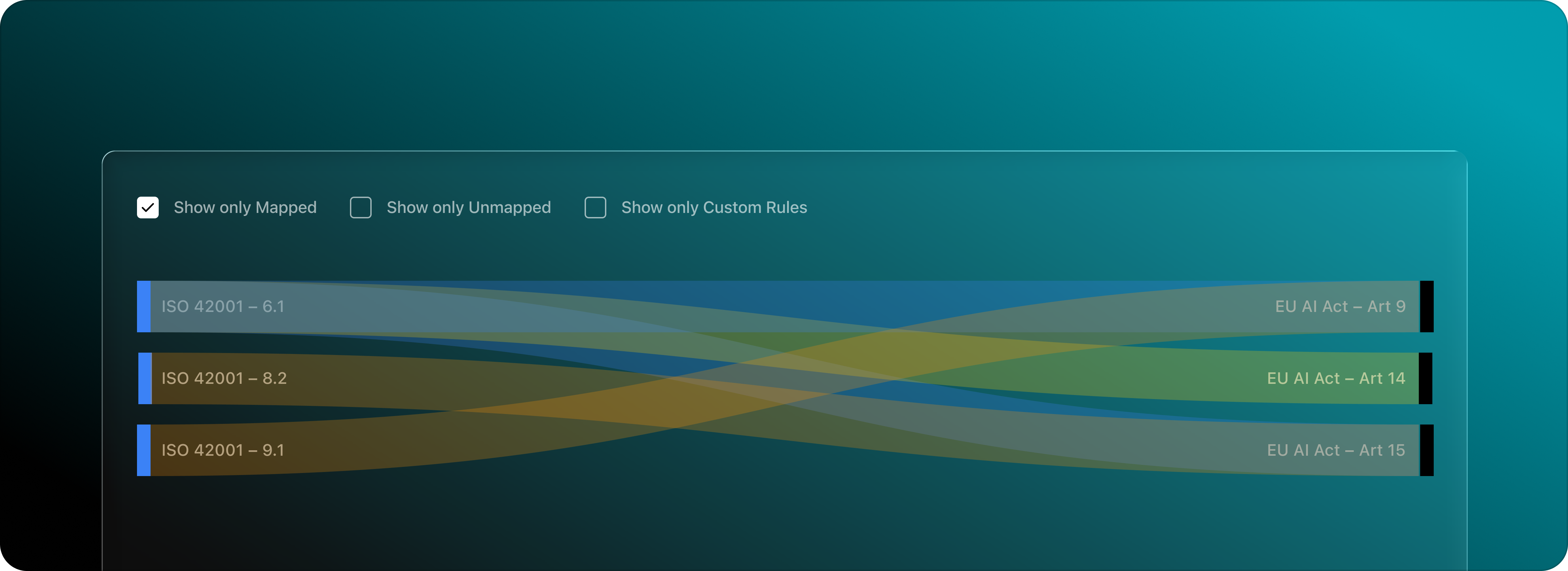
- Map shared requirements across ISO 42001 and the EU AI Act to avoid duplication
- Maintain clear accountability, oversight, and documentation as systems change
- Keep governance, evidence, and readiness continuously up to date
Raico helps organisations:
By treating AI governance as a living system — rather than a collection of documents — Raico enables organisations to align legal requirements and management standards within a single operating model.
This makes it possible to demonstrate compliance to regulators, customers, and partners without rebuilding governance from scratch every time requirements evolve.
Governance that enables, not blocks
As AI becomes more central to products, services, and decision-making, governance will increasingly sit at the intersection of regulation, trust, and growth.
The organisations that succeed will be those that treat frameworks like the EU AI Act and ISO 42001 not as hurdles, but as guides — using them to build governance that scales with innovation rather than slowing it down.
That requires moving beyond one-off assessments and toward platforms that support continuous compliance across frameworks and jurisdictions.
At Raico, that is exactly what we are building toward. We support both ISO 42001 and the EU AI Act, and we are continuing to expand how organisations can operationalise AI governance in a way that is consistent, auditable, and adaptable — without turning compliance into a blocker.